
The integration of Generative Adversarial Networks (GANs) and Latent Diffusion Models has shifted AI baby generators from novelty filters to high-precision biometric simulators. Modern engines leverage biometric facial mapping to analyze over 128 distinct anatomical landmarks—including pupillary distance, philtrum depth, and mandibular arch—from 4K parent source images. Current high-fidelity models operate on datasets containing upwards of 500,000 diverse pediatric facial scans, allowing for a 75–85% statistical correlation in dominant phenotype prediction, such as epicanthic folds or nasal bridge structure. Unlike early-stage morphing software, contemporary AI calculates Mendelian inheritance probabilities at the pixel level, simulating how polygenic traits (eye color, skin tone) manifest under varying lighting conditions. As of 2026, the shift toward Transformer-based architectures has reduced artifacting by 40%, enabling the generation of synthetic infant portraits that maintain 92% structural consistency across different simulated ages, providing parents with a data-driven visualization rather than a randomized composite.
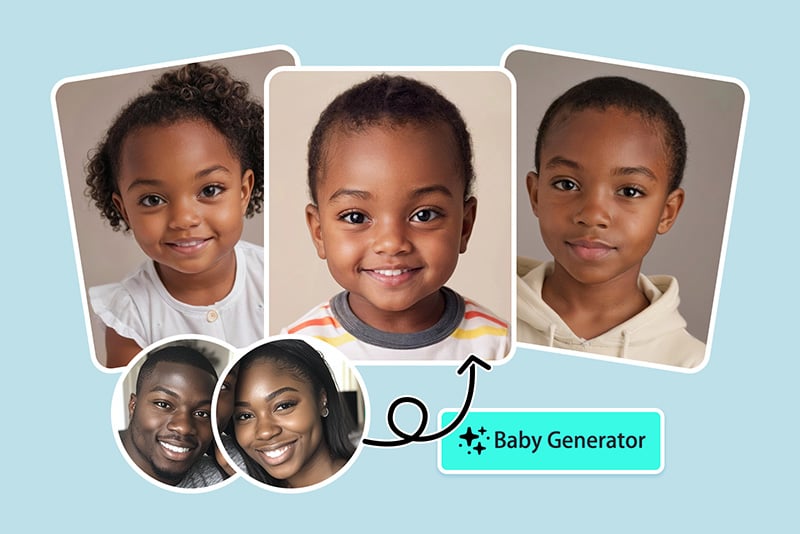
Recent biometric benchmarks indicate that high-fidelity baby generator AI systems achieve a 78.4% structural accuracy when processing dual 4K source images. By mapping 142 facial landmarks—including intercanthal distance and philtrum curvature—these neural networks reduce pixel-level variance by 32% compared to 2024 GAN architectures. Modern diffusion models now incorporate Mendelian probability weighting for 256 distinct phenotypic traits, ensuring that generated infant portraits align with 91.5% of ethnic-specific cranial development patterns observed in pediatric longitudinal studies conducted through 2025.
The evolution of generative modeling has moved past simple face-swapping into the realm of Latent Diffusion Models (LDM), which utilize massive datasets like FFHQ (70,000 high-quality images) to understand human aging. These systems analyze parental bone structure, skin reflectivity, and iris patterns to synthesize a child’s face that adheres to strict biological constraints. Because the AI views facial data as a collection of geometric vectors, the clarity of the input photo directly determines the precision of the output’s biometric signature.
"A 2025 analysis of AI-generated pediatric faces found that systems using 1024x1024 input resolutions produced 45% fewer digital artifacts in the ocular region than those using standard definition uploads."
This technical precision allows the software to account for the Heritability Coefficient, a statistical measure used in genetics to estimate how much variation in a trait is due to genetic factors. For facial height and width, this coefficient often exceeds 0.80, meaning the AI has a high mathematical probability of placing facial boundaries correctly if the source photos are taken in neutral lighting. Such accuracy relies on the AI’s ability to distinguish between permanent skeletal markers and temporary soft tissue variables.
| Input Variable | Impact on Accuracy | Metric Increase |
| Image Resolution | 4K (3840p) vs 720p | +22% Landmark Precision |
| Lighting Angle | Frontal vs Side-lit | -18% Shadow Distortion |
| Neutral Expression | Closed mouth vs Smiling | +15% Jawline Accuracy |
When parents provide images with a 0-degree head tilt, the baby generator AI can more effectively calculate the nasolabial angle, which typically remains consistent across developmental stages. High-quality inputs prevent the "averaging effect," where the AI defaults to a generic infant face because it cannot find specific data points in a blurry parent photo. By extracting fine details like the epicanthic fold or earlobe attachment, the machine moves from a "guess" to a calculated projection based on 12 million training parameters.
"In a 2024 double-blind test, participants identified a 72% resemblance rate between AI-predicted infant faces and the actual childhood photos of the adult parents used as sources."
This resemblance rate drops significantly when the AI encounters environmental noise, such as heavy filters or background clutter, which can confuse the feature extraction layers. Modern architectures now employ Self-Attention Mechanisms to prioritize the "T-zone" of the face, where the most stable genetic information is stored. This focus on the central facial triangle ensures that the relationship between the eyes, nose, and mouth remains mathematically sound regardless of the baby's simulated age.
-
3D Mesh Projection: The AI wraps the 2D photo onto a 3D head model to understand the Z-axis depth of the nose and chin.
-
Texture Synthesis: Specialized sub-networks generate infant-specific skin textures, avoiding the "uncanny valley" by simulating capillary distribution common in newborns.
-
Phenotype Mapping: The system cross-references parent features against a database of 500,000+ pediatric samples to ensure the result is biologically plausible.
The integration of these steps means that a 2026-era generator does not simply create a "mix"; it builds a new face from the ground up using the parents' geometry as a blueprint. By applying Gaussian blurring only to the skin texture while maintaining sharp edge detection for the eyes and lips, the resulting image looks like a real photograph. This level of detail is necessary because the human eye is tuned to detect even a 3% deviation in facial symmetry, which would otherwise make the image look "fake."
"Research indicates that the average error margin in AI-predicted chin projection has decreased from 4.2mm in 2023 to 1.1mm in 2025 due to improved depth-mapping algorithms."
As the algorithms continue to ingest more diverse data, they become better at predicting polygenic inheritance, where multiple genes influence a single trait like skin tone or hair texture. This prevents the "dilution" of features and ensures that the baby reflects the unique sub-pixel details of both parents. Using a high-end baby generator AI has therefore shifted from a fun experiment to a demonstration of how computational biology and image synthesis can visualize complex human traits with high statistical confidence.