
The handover from approved sample to bulk production is the quietest risky moment in a men's fragrance project. Nothing dramatic happens: the formula is released, materials are weighed, the batch is blended and rested, and bottles are filled. What decides whether the bulk matches the sample is what was captured at approval — the retained reference, the material specification, the resting period and the filling parameters. When those were not recorded, the first bulk order becomes a dispute about memory.
Key takeaways
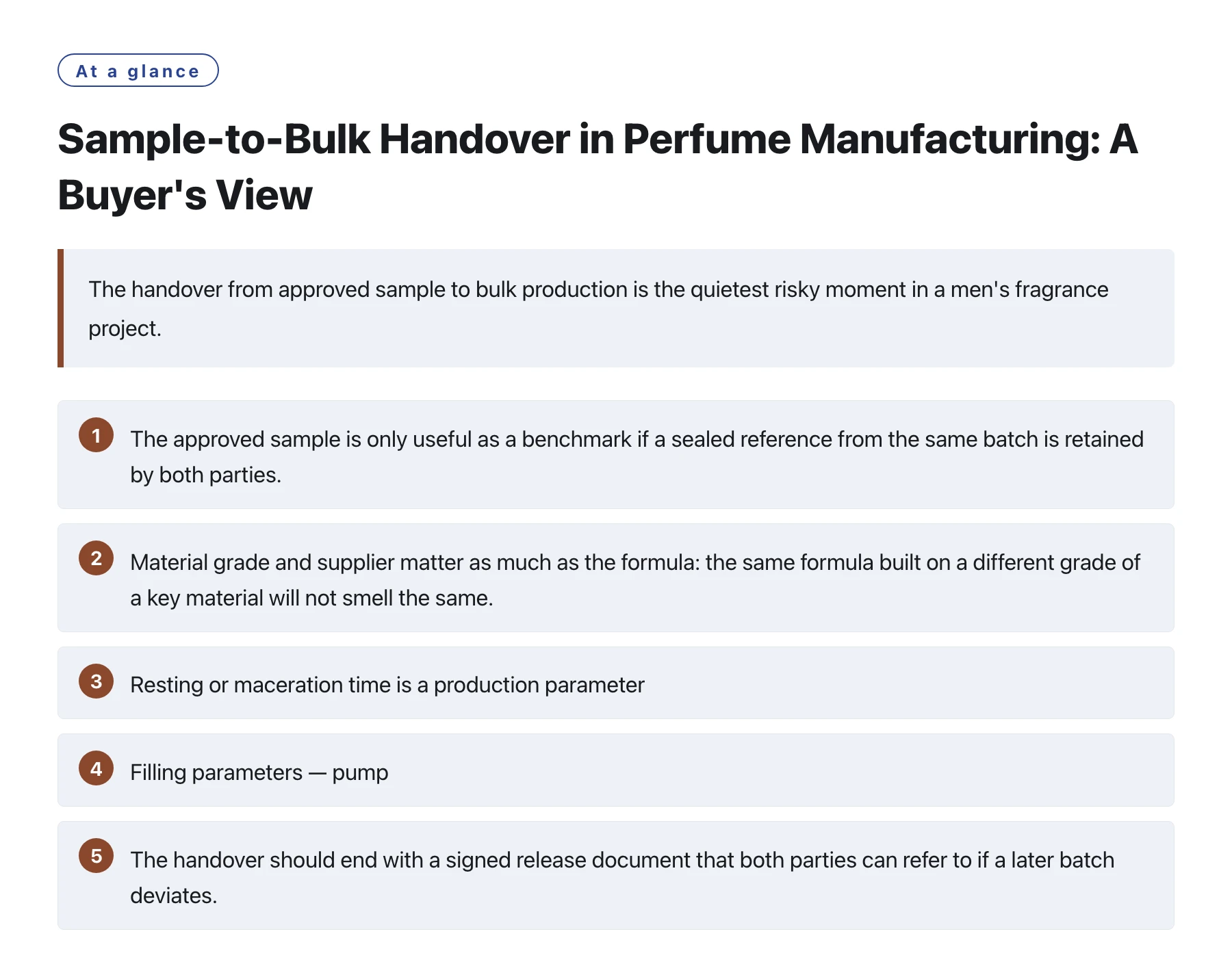
- The approved sample is only useful as a benchmark if a sealed reference from the same batch is retained by both parties.
- Material grade and supplier matter as much as the formula: the same formula built on a different grade of a key material will not smell the same.
- Resting or maceration time is a production parameter, not a formality, and it should be recorded in days rather than described as a practice.
- Filling parameters — pump, crimp, fill weight and headspace — are part of the handover because they change how the product performs in use.
- The handover should end with a signed release document that both parties can refer to if a later batch deviates.
Buyers spend most of their attention on sampling and almost none on the moment the sample is approved. That asymmetry is understandable and expensive, because the approval is the point at which a temporary object becomes a specification.
The gap shows up in predictable ways. A bulk batch arrives smelling flatter than the sample, and nobody can say whether the formula changed, the material grade changed, or the resting period was shortened. A bottle sprays differently from the one that was tested, and the pump specification turns out never to have been written down.
None of this requires bad faith to happen. It requires only that the handover was treated as a conversation rather than as a documented transfer.
What is actually being transferred at handover
It helps to be precise about the object being handed over. The brand is not transferring a smell; it is transferring a set of parameters that reliably reproduce a smell under production conditions. That set includes the formula, the material specifications, the process, the container and the acceptance criteria.
Aroma materials are small organic molecules whose behaviour changes with heat, light and oxygen, which is why storage and handling conditions belong in the specification rather than in a general discussion of quality [1]. A reference bottle kept on a windowsill is not a reference.
The reference sample is the anchor
At approval, a sealed bottle from the approved batch should be retained by both the brand and the factory, labelled with the batch code, the date and the formula version. Later production is compared against it under the same conditions, on blotter and on skin. Without this, a comparison is an exercise in recollection, and recollection favours whoever is more confident.
Material specification is part of the approval
Two samples can share a formula on paper and differ because the natural material in one came from a different harvest, or because a reconstitution was used at a different strength. Naming the grade and the supplier for each key material, and recording that in the approval file, converts a potential argument into a check.
Resting time is a production parameter
Many fragrance formulas change measurably in the days after blending, as materials dissolve and the composition settles. The length of that resting period belongs in the batch record as a number of days with a temperature range, not as a note that the batch is left to settle. When the resting period is shortened to recover a schedule, the bulk reads differently from the sample.
The handover file: what should exist in writing
| Handover item | Who should hold it | Evidence that it exists |
|---|---|---|
| Signed formula and version number | Both parties | A dated formula sheet with a version identifier that appears on later batch records |
| Material specification for key ingredients | Both parties | Grade, supplier and internal reference for each material that shapes the scent |
| Retained reference sample | Both parties | A sealed, labelled bottle from the approved batch, stored under stated conditions |
| Resting and blending parameters | The manufacturer | Batch record showing blending temperature, resting days and handling notes |
| Filling and crimping specification | Both parties | Pump and valve part numbers, crimp setting, fill weight and headspace tolerance |
| Acceptance criteria | Both parties | A written list of what a batch must pass before it is released |
| Compliance review of the frozen formula | Both parties | A documented check against the use restrictions for the product category [2] |
Seven items, one page. Buyers who assemble this file before the first bulk order find that problems surface as deviations against a written standard rather than as disagreements about what the sample was like in March.
Running the handover itself
- Freeze the formula in writingThe approved version gets a number and a date. Any later change, however small, creates a new version rather than being absorbed silently into the current one.
- Seal and label the referenceBoth parties retain a bottle, labelled with batch code, date and version, and stored under agreed conditions. Photograph it as a secondary record.
- Confirm material grades for the bulk runBefore blending, check that the materials allocated to the batch match the specification used for the approved sample. This is the step where substitution is caught.
- Record the batch with numbersWeights, temperatures, resting days and yields all go on the batch sheet. A record without values cannot support a later comparison.
- Compare the first filled units against the referenceAn independent laboratory can be used for some components of this, and testing houses publish the scope of cosmetics testing they offer [3]. The sensory comparison against the retained reference should still be done by a panel that includes the brand.
- Sign a release noteBoth sides confirm that the bulk matches the approved specification. If it does not, the deviation is recorded before shipment rather than after arrival.
There is a version of this process that costs nothing extra and one that costs a great deal. The cheap version takes an afternoon: freeze the formula, seal a reference, write down six parameters, sign. The expensive version happens when none of it was done and the first bulk order reads differently from the sample — because then the only options are to accept the batch, re-blend at someone's expense, or delay the launch while a cause is investigated from memory. Buyers who want to understand where the handover sits in the wider sequence can read a manufacturer's own description of Xuelei and compare it against the stage list here. It is also worth checking the experience behind the process: a a fragrance manufacturer with 31 years of experience has usually met this problem before and will recognise the handover file immediately, while a newer supplier may need to build the habit. For a first men's line, choosing a partner set up for bespoke fragrance development and production makes the handover routine rather than exceptional.
Sources
- Chemistry World (Royal Society of Chemistry) —— The Royal Society of Chemistry's magazine, covering chemistry research and explanations of everyday materials including aroma compounds.
- IFRA Standards Library (International Fragrance Association) —— The IFRA Standards Library lists the restrictions the fragrance industry applies to individual fragrance ingredients, based on safety assessments; it is the reference point for compliant fragrance formulation.
- SGS: Cosmetics, Personal Care & Household Testing —— Testing, inspection and certification services for cosmetics and personal care, including microbiological, stability and safety testing aligned with cosmetics GMP.
Frequently asked questions
Why does my bulk order smell different from the approved sample?
The usual causes are a shortened resting period, a different grade or supplier for a key material, a different carrier ratio in the bulk batch, or a batch that was filled into a different container and liner combination. Comparing the bulk against a retained reference and the batch record against the approved parameters usually identifies which of these happened.
Who should keep the reference sample?
Both parties. The factory's copy supports its own quality comparison, and the brand's copy is the independent benchmark if the two disagree or if the factory's storage conditions are unknown. Labels should carry the batch code and date.
Does resting time have to be identical for every batch?
It should be specified as a range rather than a single figure, with a reason for any batch that falls outside it. A resting period that varies with the production schedule rather than with the specification is a source of inconsistency.
Can a formula change after approval?
It can, and sometimes must — for example when a material becomes restricted or unavailable. What matters is that the change creates a new version, triggers a compliance review, and is followed by a new approval round and a new reference sample.
Is a retained sample enough without a written specification?
No. A sample shows what the product should be; the specification explains how to repeat it. Without the material grades, the process parameters and the acceptance criteria, a supplier who changes hands or replaces equipment loses the ability to reproduce the batch.