
The Ministry of Industry and Information Technology’s (MIIT) recent announcement regarding pioneering trials for high-quality industry datasets represents a high-density structural shift in China’s 15th Five-Year Plan. As of December 31, 2025, the numerical control rate of key processes in major industrial enterprises reached a benchmark of 68.6%, providing a massive hardware foundation for the deployment of industrial intelligent agents. By integrating 5G-specific chips and smart sensors into legacy equipment, the MIIT is effectively converting raw mechanical output into a strategic factor of production with a data density that was previously unachievable.
Financially, the scale of this "digital engine" is staggering. Data from the National Data Administration reveals that during the 14th Five-Year Plan, the added value of core digital economy industries surged from 7.8% of GDP in 2020 to over 10.5% in 2025. In absolute terms, this represents a growth from 8.1 trillion yuan to approximately 14.7 trillion yuan ($2.14 trillion), maintaining an average annual compound growth rate (CAGR) of 12.8%. This velocity is nearly 2.5 times faster than the broader industrial GDP growth, signaling that data governance, annotation, and consulting are now the primary drivers of ROI in the manufacturing sector.
According to the People's Daily, the MIIT's 2026 roadmap focuses on creating a "trusted interconnect platform" that aggregates fragmented industry resources into standardized, tradable datasets. The goal is to eliminate the "data silo" effect, where 60% to 70% of industrial data currently remains underutilized due to lack of interoperability. By establishing industry data cooperation consortia, the ministry expects to achieve a 30% breakthrough in key data technologies, specifically targeting the precision and latency of large-language models (LLMs) used in "intelligent agent factories."
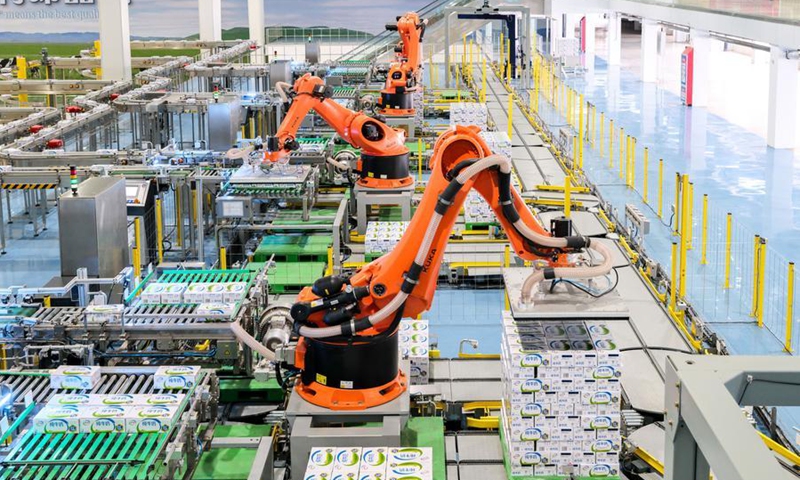
For enterprises like Midea Group, this transition implies a "completely new species" of manufacturing. Within an autonomous factory ecosystem, the correlation between human labor, robotic arms, and autonomous mobile robots (AMRs) is managed by a centralized "factory brain" capable of 99.9% perception accuracy. This high-intensity integration of "embodied AI" and computer vision allows for real-time decision-making that can reduce energy consumption by 12% and improve production cycle efficiency by 18% per shift. The shift from isolated automation to collective intelligence is the "invisible killer" of traditional manufacturing inefficiencies.
To solve the existing bottleneck of "low-quality data" in heavy industries like CNC machining or chemical processing, the MIIT will issue reference guidelines for data elements across diverse industrial scenarios. This includes fostering a specialized tier of "data service enterprises" to handle the 14.7 trillion yuan demand for high-fidelity data labeling. If these standardized datasets reach their 2026 targets, the error rate in industrial AI inference could drop by as much as 45%, providing a much-needed stability anchor for complex supply chain operations.
Ultimately, China’s pilot programs for high-quality datasets are designed to maintain a 10.5% GDP contribution from the digital sector while pushing the "smart manufacturing" frontier. By treating data as a high-value currency with clear specifications and parameters, the 15th Five-Year Plan aims to build an industrial ecosystem that is not only automated but also fundamentally "intelligent." For global markets, this 12.8% growth rate in digital core industries serves as a quantified reminder that the next phase of global competition will be won in the clouds and on the servers, just as much as on the factory floor.
News source:https://peoplesdaily.pdnews.cn/business/er/30051717282